How the Light in the Dark Dragon Came to Life
The Light in the Dark dragon did not begin as a finished design or even as the symbol it has become today.
It began as a 3D printing project.
Over time, through months of engineering, failed prints, redesigns, painting, and refinement, it became something much more personal.
The dragon became another expression of Light in the Dark alongside the philosophy, the rune, the artwork, and this website.
Today, every Light in the Dark dragon carries that identity. Each one is printed, assembled, and finished by hand before it leaves my workbench, whether it is going to a fellow veteran, a friend, or someone who simply connects with what it represents.
This is the story of how the Light in the Dark dragon came to life.
The Original Idea
The Light in the Dark dragon didn’t begin with a design program or even with the idea of creating my own dragon.
It actually started with my wife.
Early in the spring, she suggested that I print a batch of articulated dragons for the summer so she could give them away. Like a lot of people in the 3D printing community, I could have simply printed one of the many crystal dragons that show up at craft fairs and vendor booths.
Instead, I found myself asking a different question.
What if I designed my own?
That question quickly became another.
What if I gave it personality?
And then another.
What if I made it part of Light in the Dark?
From that point on, the project stopped being about printing another articulated dragon.
It became about creating something original that could carry the same identity as the rune, the website, and everything else I was building around Light in the Dark.
From there, the snowball just kept rolling.
Building the Dragon
The dragon took months of work across Blender, test prints, redesigns, and physical fitting.
A part could look perfect on the screen and still fail once it came off the printer. Connections that appeared strong could snap. Joints could weld together. Clearances could be too tight to move or so loose that the parts would not hold.
The head connection became one of the major engineering challenges.
An early two-panel locking tab proved too weak and snapped during handling. The shaft and position were usable, but the locking tab needed to be stronger.
That led to a wider five-section tab with a reinforced root and a matching socket inside the head. After rebuilding both sides of the connection, the final test worked:
- The head attached easily.
- The fit was secure without being too tight.
- The head did not wobble.
- The rotation limiter worked.
- The locking tab survived.
That was one of the points where the dragon began feeling less like an experiment and more like a finished physical design.
Wings, Sockets, and Articulation
The wings needed to remain separate so they could be printed cleanly and attached after the body was finished.
The working design used a ball-and-socket connection. The socket worked, but the original wing ball needed adjustment. Increasing it by approximately three percent created a stronger fit.
Later wing sets used solid attachment balls to strengthen the connection point. The wings could then remain removable while still holding securely on the dragon.
The articulated body and tail required a different balance.
If the clearances were too small, the parts fused together during printing. If they were too large, the joints became weak or visually separated.
The production design eventually used approximately:
- 1.5 mm pins
- 2.4 mm holes
- 4–5 mm spacing between segments
- a very small bevel
- a gradual scale reduction between tail segments
Those measurements came from repeated testing rather than a single successful guess.
The Tail That Refused to Cooperate
The curved tail became one of the most difficult parts of the project.
The goal was a tail that already had a natural curved shape when it came off the printer while still allowing every segment to move.
Several versions failed because walls merged or moving pieces welded themselves to neighboring tabs. One problem area involved two connected segments identified during testing as 007 and 008. Reducing the angle around that connection from approximately 125 degrees to 120 degrees created enough separation for the joint to print free.
Different versions also tested changes to brims, print pauses, segment positions, spacing, and wall separation.
By the fourth major curved-tail version, the joints printed free and the tail moved as intended.
That successful print proved the curved tail could become part of normal production instead of remaining a one-time experiment.
Scaling Up to the XL Dragon
Once the standard dragon reached a reliable production state, I scaled it up.
The XL body was printed at approximately 175 percent, close to the practical limit of the Creality K1C’s 220 × 220 mm build plate.
The head and wings were printed separately so the body could use as much of the build plate as possible without weakening the attachment points.
The larger version preserved the important parts of the design:
- The articulated body
- The curved tail
- The engraved rune
- The full horn and broken horn
- The removable wings
- The separate head connection
The XL dragon was not simply an oversized display model. Its joints and removable parts still worked.
It also created more room for painted details and made the rune, eyes, horns, wings, and other features easier to see.
When It Became More Than a 3D Print
The dragon became more than a printed model when it began carrying the identity and meaning of Light in the Dark.
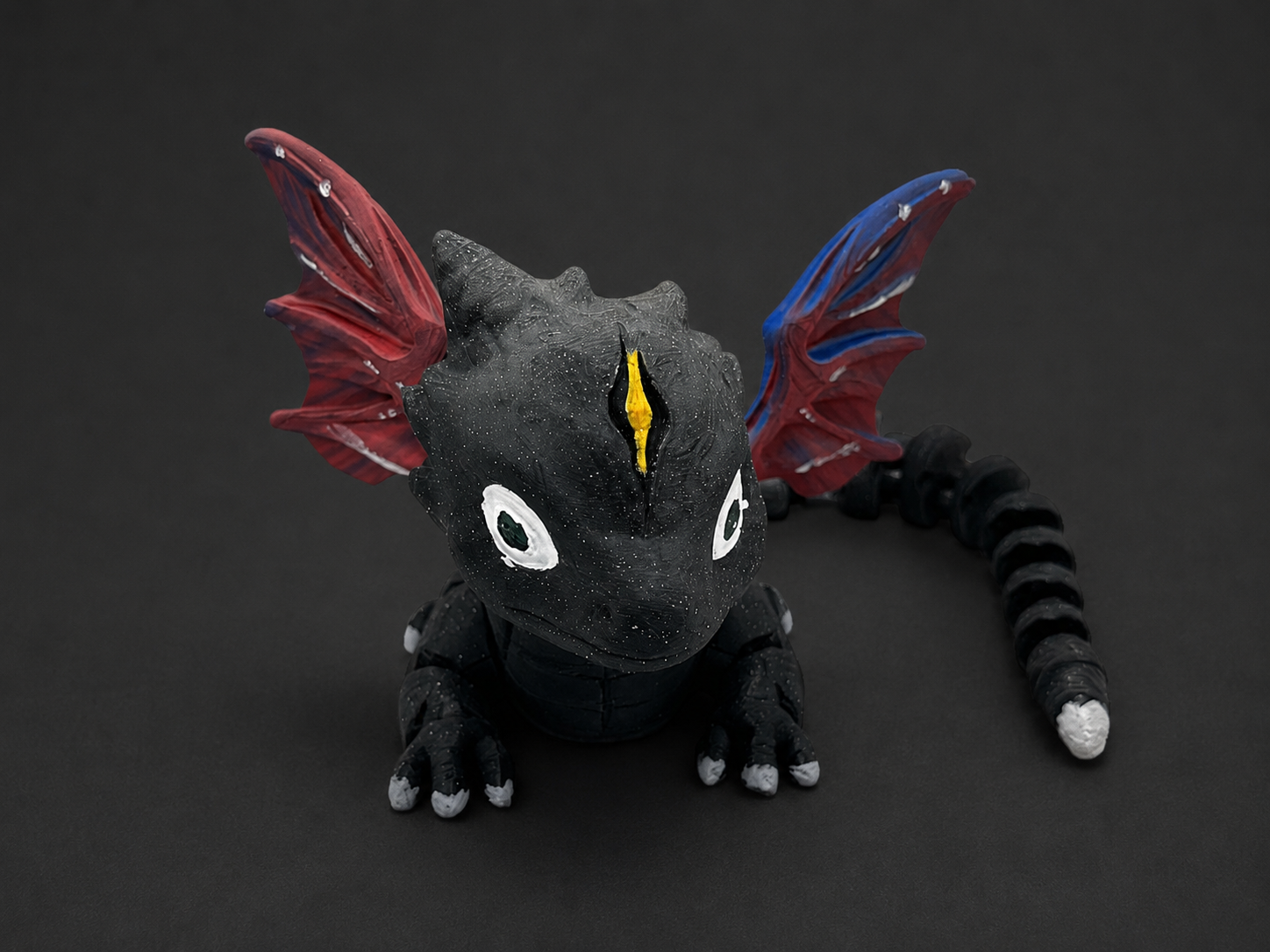
The rune is not just decoration placed on the dragon afterward. It is engraved into the forehead as a scar or mark and connects the dragon directly to the larger Light in the Dark idea.
For me, Light in the Dark means that darkness and light can exist at the same time.
The light does not erase the darkness. It is not a cure, and it is not the answer to everything. It exists beside the darkness as persistence, warmth, hope, meaning, and purpose.
The dragon became another way to make that idea physical.
The preferred original dragon has a black-speckled body and head, red-and-blue wings, a yellow forehead rune, white eyes with deep forest-green irises, silver-grey toenails, and a silver-grey tail tip.
Other dragons can use different filament colors. The rune and eyes are the main features that continue identifying them as Light in the Dark dragons.
One of My Own Lights
As the dragon evolved, I realized something else had happened that I wasn’t expecting.
Building the dragon had become one of my own Lights in the Dark.
The hours spent designing, printing, testing, painting, and improving it gave me something meaningful to work toward. Every problem solved led to another idea. Every successful print made me want to see what the next version could become.
Like many of my other Lights, the dragon did not remove the darkness.
It did not cure PTSD.
It did not make difficult days disappear.
What it did was give me hope, purpose, and something to look forward to.
Creating the dragon became another reminder that meaningful things can grow from persistence. Every redesign, every failed print, every small improvement became part of a journey that was worth continuing.
Today, the dragon is more than something I make.
Creating it is one of the things that continues helping me move forward.
Why Giving One Away Matters
Giving away one of these dragons means more to me than handing someone a printed object.
Each dragon is something I printed, assembled, finished, and painted myself. It carries the rune and the meaning I have attached to Light in the Dark.
The first completed XL canon-style dragon went to my veteran friend Tim.
I am currently finishing another XL dragon to give to Tank Tolman at Gen Con.
I see Tank as a fellow beacon—someone who uses his presence and platform to offer encouragement, connection, and belonging to other people.
A beacon does not remove the darkness around it. It stands where it is and gives off light.
The dragon is not promotional merchandise or a demand for recognition. It is something handmade that I am giving to someone whose work I respect and whose message connects naturally with that idea.
When I give away a Light in the Dark dragon, I am sharing a piece of something personal that I created.
Looking Forward
The dragon has moved beyond research and development into repeatable production.
The completed design now supports:
- Standard and XL versions
- Removable wing sets
- Different filament combinations
- Hand-painted versions
- White paint-your-own dragons
- Dragons sold or given to people who connect with their meaning
- A QR-code card connecting each physical dragon to the Light in the Dark story on PTSDTHEGAMER.com
There will still be refinements, stronger parts, larger versions, and new printing experiments.
But the dragon no longer has to be reinvented every time.
It survived the long process of being made real.
Now it can carry Light in the Dark beyond my workbench, one dragon at a time.